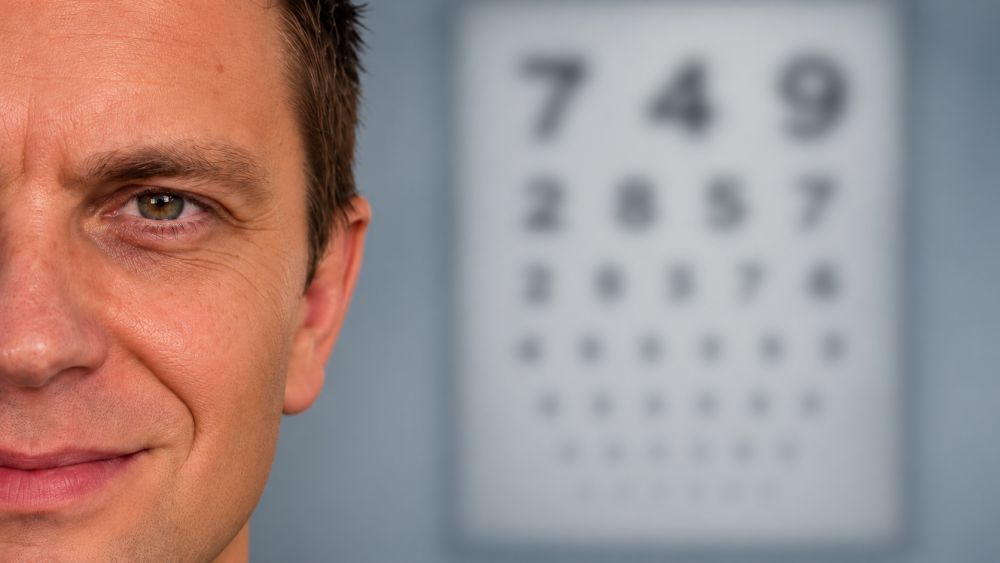
How I see
In the middle of my field of vision there is a patch – as if I were looking through frosted glass. I can make out light and dark, but I can’t recognise anything there. Further out, things get sharper.
What is it, exactly?
In my retina there are two types of sensory cells that take in light and pass it on to the brain: rods and cones. Rods make it possible to perceive light and dark and to see at dusk and at night. Cones work best in bright light and are responsible for colour vision.
In my eyes, these cells are slowly dying — first the rods, later the cones too. That is exactly what the name of my condition describes: rod-cone dystrophy.
Why does it happen?
It is a genetic condition — I was born with it, even though you can’t see it from the outside. Its prevalence in Europe is estimated at about 1 in 40,000 people — so I’m certainly not the only one, but also not someone you run into often in everyday life. It is caused by changes in certain genes that are responsible for the function of my visual cells. It progresses at varying speeds and can take very different courses even within one family. There is no cure so far.
How does it show?
For me — as for most people affected — it happens in stages:
- First: I see poorly at dusk and at night, and a loss develops in the middle of my field of vision – doctors call it a central vision loss. It’s as if I were looking through frosted glass: I can see light and dark, but I can’t recognise anything there. By now I’m missing a third to a half of my field of vision, from the inside outwards. Only at the edge can I still see sharply.
- Over time: My visual acuity and colour vision also get worse. Bright light can be uncomfortable or even dazzling.
- What remains: Many of us keep some residual vision for years — complete blindness is not an inevitable outcome, but vision becomes steadily more limited.
What does it mean for me as an athlete?
Depth perception, reacting quickly to obstacles, spotting course markings or other athletes in a race — all of that became more and more difficult over time. That’s why I switched to para triathlon: not because I gave up, but because I needed conditions in which I can keep competing fairly and safely. Today I race as a para triathlete – together with my guide.